

By Jason Feemster, POS Industry Analyst | Last Updated: January 2026
A clear, up-to-date breakdown of Toast software fees, hardware costs, payment processing rates, add-ons, and real-world monthly cost estimates for cafés, bars, fast-casual, and full-service restaurants.
Table of Contents
- 1 How We Researched Toast Pricing
- 2 Toast POS Pricing Breakdown (2026)
- 3 Toast Software Plans and Monthly Fees
- 4 Toast Payment Processing Rates
- 5 Toast Hardware Costs
- 6 Toast Add-On Costs
- 7 Toast Contract Terms and Hidden Fees
- 8 Real-World Toast Cost Examples
- 9 Pay-as-You-Go vs. Standard Pricing: Which Is Better?
- 10 Toast Pricing: Pros and Cons
- 11 Toast vs. Competitors: Quick Price Comparison
- 12 Who Should (and Shouldn’t) Use Toast
- 13 Alternatives Worth Comparing
- 14 Toast POS Pricing FAQs
- 15 Get Your Toast POS Quote
Quick answer: Most single-location restaurants pay $150–$500/month for software and add-ons, plus 2.49%–2.99% + $0.15 per transaction in processing fees. A restaurant doing $50K/month in card sales might pay $300/month in software and another $1,400+ in processing — so your real monthly Toast bill is often $1,500–$2,500+ all-in.
For multi-location or full-service operations with handhelds, KDS, online ordering, and loyalty? Expect $3,000–$5,000+/month when you factor in everything.
How We Researched Toast Pricing
We compiled this pricing guide from multiple sources: Toast’s official pricing page, live demo calls with Toast sales reps, published third-party reviews (NerdWallet, Merchant Maverick), and real restaurant owner reports from Reddit and industry forums. Toast pricing is highly variable and changes frequently, so treat these numbers as guideposts — your actual quote will depend on your specific situation.
Toast POS Pricing Breakdown (2026)
Toast pricing has three main components that stack on top of each other:
- Software subscription — your monthly plan fee ($0–$165+/month)
- Payment processing — a percentage of every card transaction (2.49%–3.50%+ per swipe)
- Hardware — terminals, handhelds, KDS screens ($500–$5,000+ upfront or financed)
The software fee gets all the marketing attention, but processing is where Toast really makes money — and where most restaurants underestimate their costs.
Toast Software Plans and Monthly Fees
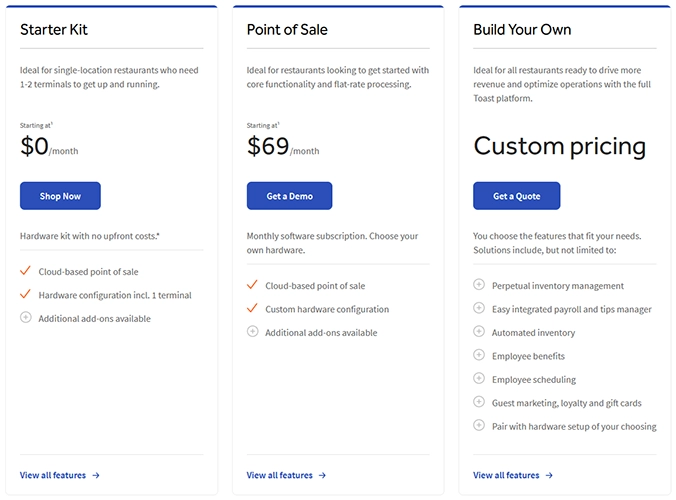
| Plan | Monthly Cost | Processing Rate | Best For |
|---|---|---|---|
| Starter Kit (Pay-as-You-Go) | $0/month | 2.99% + $0.15 | New restaurants, food trucks, very low volume |
| Starter Kit (Standard) | $69/month | 2.49% + $0.15 | Small cafés, single-location with 1-2 terminals |
| Point of Sale | $69/month | 2.49% + $0.15 | Restaurants wanting to pay for hardware upfront |
| Essentials | ~$165/month | 2.49% + $0.15 | Restaurants needing online ordering included |
| Growth / Custom | Custom quote | Negotiable | Multi-location, high-volume, enterprise |
Toast Payment Processing Rates
Unlike Square or Clover, you cannot use your own payment processor with Toast. You’re locked into Toast Payments, which means these rates are non-negotiable for most small restaurants:
| Transaction Type | Pay-as-You-Go Rate | Standard Rate |
|---|---|---|
| Card Present (in-person) | 2.99% + $0.15 | 2.49% + $0.15 |
| Card Not Present (online orders) | 3.50% + $0.15 | 3.50% + $0.15 |
| Keyed-in transactions | 3.50% + $0.15 | 3.50% + $0.15 |
How this compares:
- Square for Restaurants: 2.6% + $0.10 (in-person)
- Clover: 2.3% + $0.10 (in-person)
- SpotOn: 1.99% + $0.25 (in-person)
Toast’s rates are on the higher end. For a restaurant processing $80,000/month in card sales, that 0.2%–0.5% difference versus competitors adds up to $160–$400/month in extra fees.
Toast Hardware Costs
Toast uses proprietary hardware — you can’t use iPads or bring your own terminals. Here’s what the equipment costs:
| Hardware | Price Range | What It Does |
|---|---|---|
| Toast Flex Terminal | $799–$999 | Main countertop POS terminal |
| Toast Go 2 Handheld | $609–$627 | Tableside ordering and payments |
| Kitchen Display System (KDS) | $499–$699 | Digital ticket screen for kitchen |
| Guest Self-Service Kiosk | $799–$999 | Customer-facing ordering kiosk |
| Toast Tap Payment Device | $249–$299 | Contactless card reader |
| Receipt Printer | $149–$199 | Thermal receipt printing |
| Cash Drawer | $119–$149 | Standard cash drawer |
| Starter Kit Bundle | $0–$799 | Terminal + basic accessories (pay-as-you-go = $0 upfront) |
Typical hardware costs by restaurant type:
- Small café (1 terminal): $800–$1,200
- Fast-casual (2 terminals + KDS): $2,000–$3,500
- Full-service (3 terminals + 2 handhelds + 2 KDS): $5,000–$8,000
Toast offers 0% financing on hardware, which spreads the cost over time but increases your monthly payment.
Toast Add-On Costs
This is where Toast gets expensive fast. The base POS is just the starting point — most restaurants end up adding several modules:
| Add-On | Monthly Cost | Notes |
|---|---|---|
| Online Ordering | $75/month | Or included in Essentials plan (~$165/mo) |
| Toast Delivery Services | $75/month + fees | Third-party delivery integration |
| Loyalty Program | $50/month | Points-based rewards |
| Gift Cards | $50/month | Physical and digital gift cards |
| Email Marketing | $75/month | Campaigns and automation |
| Toast Payroll | $69/month + $9/employee | Full payroll processing |
| Team Management | $25–$50/month | Scheduling, time tracking |
| Inventory Management | Custom quote | Recipe costing, waste tracking |
| Catering & Events | Custom quote | Large order management |
| Multi-Location Management | Custom quote | Centralized reporting and controls |
The add-on trap: A restaurant that starts at $69/month can easily hit $300–$400/month once they add online ordering, loyalty, and gift cards. Factor this into your budget from day one.
Toast Contract Terms and Hidden Fees
This is the part most Toast reviews gloss over. Before you sign:
- Contract length: Most Toast agreements are 2 years. Some promotions require 3-year commitments.
- Early termination fee: If you cancel early, you’ll owe the remaining balance on hardware plus potential software fees. We’ve seen ETFs range from $1,000 to $5,000+.
- Rate increases: Toast can raise processing rates with 30 days’ notice.
- Auto-renewal: Contracts typically auto-renew, so mark your calendar 60–90 days before renewal to renegotiate or cancel.
- Hardware ownership: Even after paying off hardware, it only works with Toast. If you switch POS systems, the hardware becomes a paperweight.
Real-World Toast Cost Examples
Here’s what actual restaurants might pay, based on common setups we’ve seen:
Example 1: Coffee Shop / Small Café
- 1 Toast Flex terminal
- Starter Kit with standard pricing ($69/month)
- $25,000/month in card sales
- No add-ons
| Cost Type | Monthly Amount |
|---|---|
| Software | $69 |
| Processing (2.49% + $0.15 × ~800 transactions) | ~$743 |
| Hardware (paid upfront) | $0 |
| Total Monthly Cost | ~$812 |
Example 2: Fast-Casual Restaurant
- 2 terminals, 1 KDS
- Point of Sale plan ($69/month)
- Online ordering add-on ($75/month)
- $60,000/month in card sales (70% in-person, 30% online)
| Cost Type | Monthly Amount |
|---|---|
| Software + Online Ordering | $144 |
| Processing — in-person ($42K × 2.49%) | ~$1,046 |
| Processing — online ($18K × 3.50%) | ~$630 |
| Hardware (financed over 24 months) | ~$125 |
| Total Monthly Cost | ~$1,945 |
Example 3: Full-Service Restaurant with Bar
- 3 terminals, 3 handhelds, 2 KDS screens
- Custom/Growth plan (~$200/month estimated)
- Online ordering, loyalty, gift cards, team management
- $120,000/month in card sales
| Cost Type | Monthly Amount |
|---|---|
| Software + Add-ons | ~$400 |
| Processing (blended ~2.6% on $120K) | ~$3,120 |
| Hardware (financed) | ~$275 |
| Total Monthly Cost | ~$3,795 |
The pattern: Processing fees are 70–80% of your total Toast cost. The software subscription is almost a rounding error by comparison.
Pay-as-You-Go vs. Standard Pricing: Which Is Better?
Toast’s pay-as-you-go option sounds appealing — $0/month software, free hardware upfront. But you pay for it in higher processing rates.
Here’s the math:
| Monthly Card Sales | Pay-as-You-Go Cost (2.99%) | Standard Cost ($69 + 2.49%) | Difference |
|---|---|---|---|
| $10,000 | $299 | $318 | PAYG saves $19 |
| $15,000 | $449 | $443 | Standard saves $6 |
| $25,000 | $748 | $691 | Standard saves $57 |
| $50,000 | $1,495 | $1,314 | Standard saves $181 |
| $75,000 | $2,243 | $1,937 | Standard saves $306 |
Bottom line: Pay-as-you-go only makes sense if you’re processing under ~$14,000/month in card sales. Above that, you’re losing money every month.
Toast Pricing: Pros and Cons
✅ Where Toast Pricing Works
- You want an all-in-one platform and don’t mind paying a premium for convenience
- You plan to use handhelds, KDS, online ordering, and loyalty — Toast’s integrated ecosystem shines here
- You’re a multi-location operator who needs centralized reporting
- You value 24/7 support and restaurant-specific hardware built for grease, heat, and spills
❌ Where Toast Pricing Hurts
- You’re cost-conscious and want the lowest possible processing rates
- You want to use your own payment processor or negotiate rates independently
- You don’t want to sign a 2-year contract
- You’re a small, low-volume operation where simpler systems (Square, Clover) would cost less
- You might switch POS systems in the future — Toast’s proprietary hardware has zero resale value
Toast vs. Competitors: Quick Price Comparison
| POS System | Monthly Software | Processing Rate | Contract | Use Own Processor? |
|---|---|---|---|---|
| Toast | $0–$165+ | 2.49%–2.99% + $0.15 | 2 years typical | No |
| Square for Restaurants | $0–$60+ | 2.6% + $0.10 | Month-to-month | No |
| Clover | $14.95–$84.95+ | 2.3% + $0.10 | Varies by reseller | Limited |
| SpotOn | $0–$99+ | 1.99% + $0.25 | Month-to-month available | No |
| Lightspeed Restaurant | $189–$399+ | 2.6% + $0.10 | Annual | Limited |
| TouchBistro | $69+ | Varies (choose processor) | Annual | Yes |
Our take: Square is the easiest low-risk option for small restaurants. SpotOn often beats Toast on processing rates. TouchBistro gives you processor flexibility. Toast wins on features and restaurant-specific design — but you pay for it.
Who Should (and Shouldn’t) Use Toast
✅ Toast is a good fit if:
- You’re a serious restaurant operation planning to invest in technology (handhelds, KDS, online ordering)
- You want everything under one roof and don’t mind the cost
- You do $50K+ monthly in sales where Toast’s features can drive efficiency and revenue
- You’re opening multiple locations and need centralized management
❌ Consider alternatives if:
- You’re a small café or food truck doing under $20K/month — Square is simpler and cheaper
- You want to negotiate your own processing rates — look at SkyTab or traditional POS with separate merchant account
- You hate long-term contracts — Square and SpotOn offer month-to-month
- You’re on a tight budget and just need basic POS functionality
For a deeper look at Toast’s features, interface, and real-world performance, see our complete Toast POS review.
Alternatives Worth Comparing
- Square for Restaurants — Free plan available, no contracts, lower barrier to entry. Best for small operations.
- Lightspeed Restaurant — Strong for multi-location and inventory-heavy concepts. Higher software cost but solid features.
- SkyTab POS — Free hardware programs and competitive processing. Worth a quote if budget matters.
- TouchBistro — iPad-based, lets you choose your own processor. Good middle ground.
- SpotOn — Lower processing rates (1.99% + $0.25), month-to-month options available.
Toast POS Pricing FAQs
Is there a free version of Toast POS?
Yes and no. Toast offers a $0/month Starter Kit under its pay-as-you-go model, which includes free hardware. But you pay higher processing fees (2.99% + $0.15 vs. 2.49% + $0.15), so it’s not truly “free” — you’re just paying through transactions instead of a monthly bill. For most restaurants doing over $15K/month in card sales, the standard $69/month plan costs less overall.
How much does Toast POS really cost per month?
It depends heavily on your card volume. A small café might pay $800–$1,200/month total (software + processing). A busy full-service restaurant can easily hit $3,000–$5,000/month. The software subscription ($69–$200+) is the small part — processing fees (2.49%–3.50% of every transaction) make up the bulk of your bill.
Can I use my own payment processor with Toast?
No. Toast requires you to use Toast Payments. This is one of the biggest complaints about the system — you can’t shop for better rates or use an existing merchant account. If processor flexibility matters to you, look at TouchBistro or a traditional POS that supports third-party processing.
What is Toast's payment processing rate?
Standard rate is 2.49% + $0.15 per in-person transaction (if you pay for hardware upfront). Pay-as-you-go is 2.99% + $0.15. Online and card-not-present transactions are 3.50% + $0.15. High-volume restaurants may negotiate custom rates, but most small operators get the standard pricing.
Does Toast require a contract?
Yes. Most Toast agreements are 2-year contracts with early termination fees. Some promotions may require 3-year commitments. Contracts typically auto-renew, so set a reminder to review before your renewal date if you want to renegotiate or switch.
How much does Toast hardware cost?
Individual terminals run $799–$999, handhelds are ~$627, and KDS screens are $499–$699. A basic single-terminal setup costs $800–$1,200. A full-service restaurant with multiple terminals, handhelds, and KDS might spend $5,000–$8,000+ on hardware. Toast offers financing to spread costs over time.
Is Toast worth the price?
For serious restaurant operations that will use Toast’s full ecosystem — handhelds, KDS, online ordering, loyalty, marketing — the premium can be justified through efficiency gains and additional revenue. For small, simple operations, Toast is often overkill. A café doing $15K/month probably doesn’t need Toast’s complexity and cost when Square would work fine at half the price.
Get Your Toast POS Quote
Toast pricing is customized based on your restaurant type, volume, hardware needs, and which features you want. The fastest way to get accurate numbers is a direct quote — most operators get full pricing details within 15–20 minutes on a demo call.
Before your call, know your monthly card volume, how many terminals/handhelds you need, and which add-ons matter to you. This helps you get an apples-to-apples quote you can compare against competitors.

Jason Feemster
POS systems expert and founder of POSUSA.com, a trusted industry resource since 2011. With over a decade of hands-on experience testing and reviewing point-of-sale systems, he helps business owners choose solutions that actually fit their needs.