

Vibe Retail POS
$19.00
 Jason Feemster
Vibe Retail POS Review: Pricing, Features & Pros vs Cons
Updated March 2026 • Verified Q1 2026
Table of Contents
- 1 Pros & Cons
- 2 Vibe Retail Pricing
- 3 Payment Processing
- 4 Key Features
- 5 Hardware
- 6 Real User Feedback
- 7 Vibe Retail vs Other Retail POS Systems
- 8 Who Should Use Vibe Retail POS?
- 9 Industries Covered
- 10 Frequently Asked Questions
- 10.1 How much does Vibe Retail POS cost?
- 10.2 Can I use my own payment processor with Vibe Retail?
- 10.3 Is there a contract or cancellation fee?
- 10.4 Does Vibe Retail work for restaurants?
- 10.5 Does Vibe POS work offline?
- 10.6 How does Vibe Retail compare to Lightspeed for retail?
- 10.7 How does Vibe compare to Shopify POS for retail?
- 10.8 How does Vibe Retail compare to Square for Retail?
- 11 Final Verdict
👉 Compare Vibe Retail and Find the Best POS System
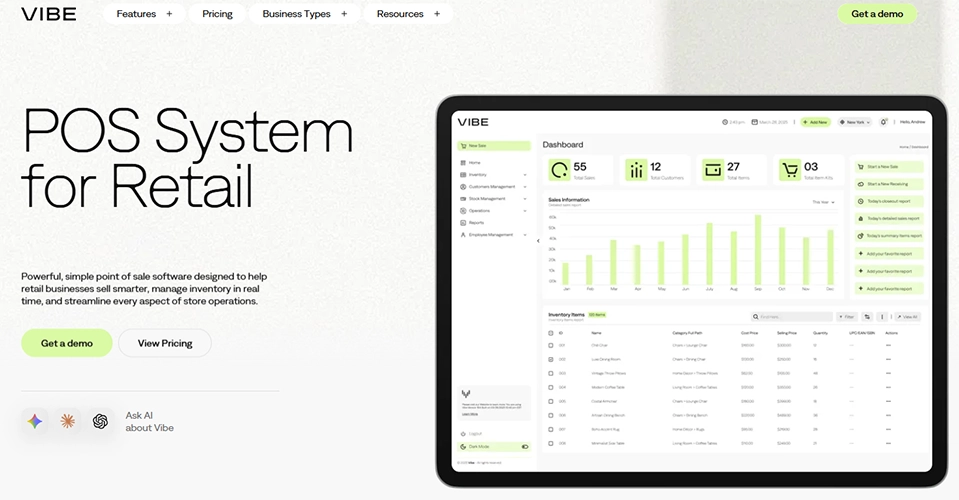
Vibe Retail caught my attention because it’s one of the few POS companies that went all-in on retail without trying to bolt on restaurant features as an afterthought. If you’ve ever used a POS system that was clearly designed for restaurants first and then had “retail mode” tacked on, you know what I mean. Vibe skipped that entirely and built their platform around inventory management, multi-location sync, and omnichannel selling from the ground up.
The feature list is aggressive for the price point. Appointments, work orders, e-commerce, loyalty, and multi-store management are all built into the Pro plan. That’s the kind of bundle you’d normally pay Lightspeed prices for. Whether the execution matches the feature list is the real question, and that’s what we’re going to dig into.
Pros & Cons
- Starts at $19/mo, no contracts
- Built for retail, not a restaurant hybrid
- Built-in e-commerce
- Appointments and work orders included
- Real-time multi-location sync
- Works with existing hardware
- 24/7 support on all plans
- Dedicated migration specialist
- VibePay required for processing
- Essential plan has item limits
- Some features still rolling out
Vibe Retail Pricing
Vibe keeps things simple with three plans and no long-term contracts. You pay month-to-month and can cancel anytime from your dashboard.
| Plan | Monthly Cost | Registers | Users | Items | Key Highlights |
|---|---|---|---|---|---|
| Essential | $19/mo | 1 (max) | 2 (max) | 100 (max) | Basic reports, chat support, Vibe Capital |
| Pro ⭐ Most Popular | $97/mo | 1 included + add more | Unlimited | Unlimited | Everything: loyalty, e-commerce, appointments, work orders, offline mode, multi-location sync |
| Ultimate | $1,399/mo | 1 included + add more | Unlimited | Unlimited | Everything in Pro + API access, 10 hrs/mo custom dev, on-site implementation ($3,500 value) |
Payment Processing
Vibe Retail POS uses its own processing platform called VibePay. You cannot bring your own payment processor. This is the same model as Toast, SkyTab, and Square. If processor freedom is a priority, look at Lightspeed or KORONA POS.
| Plan | Card-Present Rate |
|---|---|
| Essential | 2.9% + 15¢ |
| Pro | 2.7% + 15¢ |
| Ultimate | 2.5% + 10¢ |
For context, Square charges 2.6% + 15¢ across the board. Lightspeed starts at 2.6% + 10¢. Vibe’s Essential plan rate is higher, though Pro and Ultimate get more competitive. If you’re processing high volume, it’s worth comparing the total cost including the software subscription, not just the rate.
Key Features
Inventory Management
This is where Vibe puts most of its weight. Real-time inventory tracking across all locations, automatic purchase orders when stock hits your reorder point, bulk product editing, demand forecasting, supplier management, and stock transfers between stores. You can use your phone camera as a barcode scanner for stock counts, which is a nice touch for smaller operations that don’t want to invest in dedicated scanning hardware.
For retailers running multiple locations, the real-time sync is the selling point. When something sells at Store A, the inventory updates at Store B instantly. If you’re currently running separate inventory counts at each location and reconciling manually, this alone could justify the switch.
E-Commerce
Built in. Not a third-party integration you’re bolting on. Your online store runs on the same platform as your in-store POS, so products, orders, inventory, and customer data stay synced automatically. This is similar to what Shopify POS does within its ecosystem, except Vibe bundles it into the POS subscription instead of treating the online store as the primary product.
Appointments Management
Staff schedules, customer profiles, and bookable services all managed from one place. This is what makes Vibe interesting for service-oriented retail businesses like salons, barber shops, bike shops doing repairs, or auto parts stores with service bays. Most general retail POS systems either don’t offer this or require a separate integration.
Work Orders
Track customer repairs and service jobs from initial quote to completion. If you run a business that handles repairs, maintenance, or custom work (electronics repair, bike tune-ups, auto service), this is a feature most retail POS platforms don’t include natively. Having it built into the same system where you manage sales and inventory means you’re not juggling separate tools.
Marketing and Loyalty
Built-in loyalty programs, customer engagement tools, and promotional features. Standard stuff for modern POS platforms, but the fact that it’s included in the Pro plan rather than sold as an add-on (looking at you, Toast) keeps costs predictable.
Reporting and Analytics
Real-time dashboards for sales, inventory levels, employee performance, and customer behavior. The Essential plan only gets basic reports. Advanced analytics require Pro or Ultimate.
Coming Soon: Vibe AI, Payroll, Self-Checkout
Vibe is marketing AI-powered features for customer segmentation, product recommendations, and dynamic pricing. Payroll and self-checkout are also listed as coming soon. These features don’t exist yet. If they’re a deciding factor for you, wait until they actually launch before committing.
Hardware
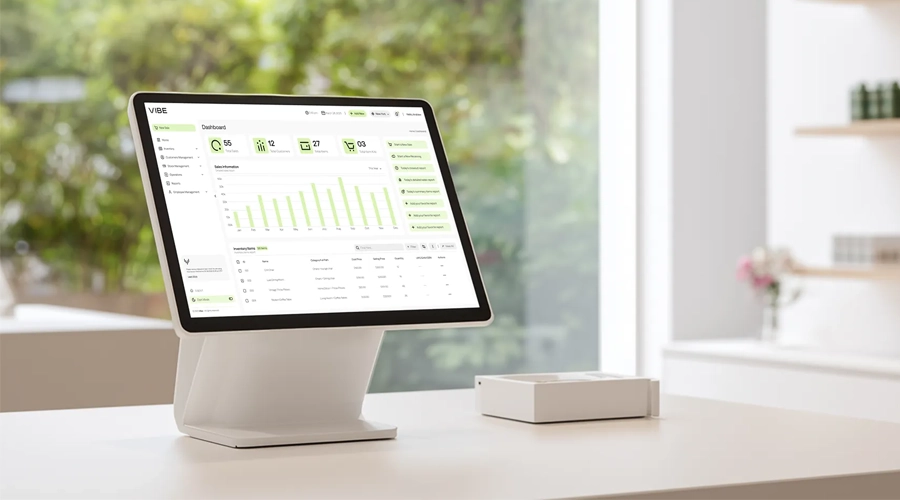
Vibe Retail POS takes the BYOD (bring your own device) approach. The platform runs on iPads, Android tablets, desktops, and compatible card readers you already own. They also offer recommended hardware kits if you want a turnkey setup.
This is different from companies like SkyTab or Toast that ship proprietary hardware. The upside: you’re not locked into specific devices and you might save money reusing what you have. The downside: no lifetime hardware warranty like SkyTab offers, because the hardware isn’t theirs to warranty.
Real User Feedback
Vibe Retail POS links to Capterra, SourceForge, Trustpilot, and G2 on their website. At the time of this review, Vibe Retail has a 4-star rating on Trustpilot based on a small number of reviews. Early users highlight ease of use, responsive customer support, and smooth data migration from other POS systems.
The testimonials on their site mention ease of use, fast onboarding, and the ability to replace multiple separate systems with one platform. Users specifically call out inventory management and the migration process as positives.
Vibe Retail vs Other Retail POS Systems
| Feature | Vibe Retail | Lightspeed | Square for Retail | Shopify POS |
|---|---|---|---|---|
| Starting Price | $19/mo | $89/mo | Free ($60/mo for Plus) | $5/mo ($79/mo Retail) |
| Contracts | None | Annual | None | None |
| E-Commerce | Built-in (Pro+) | Built-in | Separate (Square Online) | Built-in (core strength) |
| Appointments | Built-in (Pro+) | No (third-party) | Separate product | No |
| Work Orders | Built-in (Pro+) | No | No | No |
| Multi-Location | Pro+ | Yes | Plus plan | Yes |
| Own Processor | No (VibePay) | Yes (with surcharge) | No | Yes (higher fees) |
| Card-Present Rate | 2.5% – 2.9% | 2.6% + 10¢ | 2.6% + 15¢ | 2.5% – 2.9% |
Vibe’s biggest differentiator is bundling appointments and work orders directly into the POS. If your business needs those features, you’re saving the cost and hassle of separate software. But if you’re a straightforward retail store with no service component, Lightspeed and Shopify have deeper ecosystems and longer track records.
Who Should Use Vibe Retail POS?
✅ Good fit for:
- Multi-location retail stores with 2-10 locations that need real-time inventory sync across all stores without paying enterprise pricing
- Bike shops, auto parts stores, and electronics repair shops that sell products and handle repairs or service work from the same counter
- Salons, barber shops, spas, and pet groomers that need appointment scheduling and product sales in one POS system
- Boutiques and clothing stores that want to sell both in-store and online from a single inventory
- Liquor stores, convenience stores, and gift shops with large product catalogs that need strong inventory management
- Retailers switching from Lightspeed, Square, or Clover who want a lower monthly cost with no annual contract
❌ Not ideal for:
- Restaurants, bars, or food service businesses (Vibe Retail POS is retail-only, check out SkyTab or Toast)
- Retailers who want to choose their own payment processor (VibePay is required, look at Lightspeed or KORONA POS)
- Very small single-product businesses that only need basic checkout (the free tier of Square is a better starting point)
Industries Covered
Vibe Retail POS has dedicated landing pages for over 30 retail verticals: clothing, automotive parts, bike shops, electronics, liquor stores, florists, furniture, home and garden, hardware stores, health and beauty, CBD, jewelry, gift shops, pet stores, convenience stores, golf courses, salons, barber shops, spas, pharmacies, gyms, and more.
The core platform handles all of these from the same feature set. The industry pages explain how those features apply to each business type. If you’re in a niche vertical, it’s worth asking during your demo whether there are industry-specific configurations or if it’s the same system with different marketing.
Frequently Asked Questions
How much does Vibe Retail POS cost?
Vibe Retail POS starts at $19/month for the Essential plan, which includes 1 register, 2 users, and up to 100 items. The Pro and Ultimate plans offer unlimited users, unlimited items, and the full feature set. There are no long-term contracts. You pay month-to-month and can cancel anytime. Payment processing runs through VibePay at rates ranging from 2.5% + 10¢ to 2.9% + 15¢ depending on your plan.
Can I use my own payment processor with Vibe Retail?
No. Vibe Retail POS requires VibePay for all payment processing. This is the same model used by Toast, SkyTab, and Square. If using your own processor is important to you, look at Lightspeed Retail or KORONA POS, both of which allow third-party processors.
Is there a contract or cancellation fee?
No long-term contracts. Vibe Retail POS is month-to-month and you can cancel anytime from your dashboard without penalties. This gives it a flexibility advantage over Lightspeed (annual contracts) and some Clover configurations.
Does Vibe Retail work for restaurants?
No. Vibe Retail POS is built specifically for retail businesses. There are no restaurant-specific features like table management, kitchen display systems, or menu modifiers. For restaurants, check out SkyTab POS ($29.99/mo) or Toast POS ($69/mo).
Does Vibe POS work offline?
Yes, but only on the Pro and Ultimate plans. If your internet goes down, you can continue processing sales. Transactions sync when connectivity is restored. The Essential plan does not support offline mode.
How does Vibe Retail compare to Lightspeed for retail?
Both are cloud-based retail POS systems with strong inventory management. Lightspeed starts at $89/month with annual contracts and charges 2.6% + 10¢ for processing. Vibe Retail POS starts at $19/month with no contracts. Vibe includes appointments and work orders natively, which Lightspeed does not. Lightspeed has a larger app ecosystem, deeper integrations, and a longer track record with more independent reviews. Lightspeed also allows third-party payment processors, while Vibe requires VibePay.
How does Vibe compare to Shopify POS for retail?
Both offer built-in e-commerce and multi-location support. Shopify’s strength is its massive app ecosystem and online selling tools. Vibe’s edge is built-in appointments, work orders, and a retail-first design. If you’re primarily an online seller expanding to physical retail, Shopify POS is the better fit. If you’re a brick-and-mortar store that also wants to sell online, Vibe Retail POS is worth considering.
How does Vibe Retail compare to Square for Retail?
Square for Retail has a free plan and charges 2.6% + 15¢ for card-present transactions. Vibe Retail POS starts at $19/month with processing at 2.5% to 2.9%. Vibe includes built-in appointments, work orders, and native e-commerce on the Pro plan. Square handles appointments and e-commerce through separate Square products. For small single-location stores, Square’s free plan is hard to beat. For multi-location retailers or businesses that need service management, Vibe offers more in one platform.
Final Verdict
Expert Rating: ⭐ 8/10
Vibe Retail POS delivers a feature set that punches above its price point. The combination of inventory management, built-in e-commerce, appointments, and work orders in a single system is genuinely hard to find without paying Lightspeed prices. The no-contract model, existing hardware compatibility, and dedicated migration support lower the barrier to switching significantly.
The platform is still growing. A few features like AI, payroll, and self-checkout are on the roadmap and haven’t shipped yet. And the Essential plan is really just a starting point. Most serious retailers will want the Pro tier for the full experience.
Where Vibe Retail POS really stands out is for retail businesses that also handle repairs, appointments, or service work. That combination of retail POS plus service management in one platform is rare at this price point, and it’s what earns the 8. If you’re running a bike shop, salon, auto parts store, or any retail operation with a service component, Vibe Retail POS is worth a serious look.

Jason Feemster
POS systems expert and founder of POSUSA.com, a trusted industry resource since 2011. With over a decade of hands-on experience testing and reviewing point-of-sale systems, he helps business owners choose solutions that actually fit their needs.
Specification: Vibe Retail POS
|
User Reviews
Be the first to review “Vibe Retail POS”














There are no reviews yet.